
Stand up. Speak. Spark interest.
Say it in a way that people will remember. We practice it every other week — seriously, but without risk.

The most successful speaker in Slovakia
Pavel thought he was going to learn how to make toasts

Pavel Lipovský wanted to improve his English in Sydney and happened to come across a club called Toastmasters.
„"I thought it was going to be something about toast,"“ he admits. He signed up to make ends meet at the café where he worked.
There were no toasts. He stayed for nine years.
„"I like babies. Especially if they belong to someone else."“sentence from the victory speech
Pavel is a perfectionist and it cost him results for a long time. „"I can't finish the script on time because I keep changing things. I feel too much tension — I want it to be good, and I can't."“
That's why it didn't work out for years. He finished second in the club competition — Emília won.
Most people would sigh and move on. Pavel picked up the evaluation sheet and looked for what he was missing. He found: „"My speech had no point. It was just a funny story."“
But he finished second again in the Area competition — and again behind Emilia. He only made it to the Division because Emilia didn't go.
Then came the robot. He spent five hours on the train to Prague learning the script by heart. There was a large mirror in the hotel room — he practiced in front of it where he would take a step, where he would turn, where he would raise his voice. He won the division.
Before Split, he took it even more seriously. He went to practice his speech in front of foreign audiences — Bratislava, Žilina, Nitra — and found out which jokes worked. He also delivered it online to a foreign club.
His English teacher helped him with his pronunciation — she listened to the entire speech and corrected it word for word. He arrived in Croatia two days in advance: he spent the first day with his family, sent them to the beach on the second, and rehearsed out loud most of the day.
„"I didn't compete in Split. I didn't think about the competition or my opponents at all. I just wanted to make the audience laugh."“
He won with a speech about how he became a father.
— Pavel Lipovský, winner of the District humorous speech competition

Winner of the District competition, Split 2026
Four components
What does the speaker's growth consist of?
Prepared speeches are the foundation. The other three components expand on them — and make you a well-rounded speaker and leader.
Prepared speeches
You write a speech, deliver it live, and immediately find out what people remember about it.
Improvisations
You get a topic you didn't expect and two minutes. The most fun part of the evening — and ideal if you came as a guest and want to try it out.
Rating and feedback
One person watches you all evening. They tell you what worked and one thing to try differently next time. It's not criticism — it's guidance.
Club and team management
You host the evening, you chair the meeting, you take on organizational roles. You lead real people, not a case study.
The heart of the club
I will prepare, present, receive feedback
The core of Toastmasters. You prepare a speech, present it with a specific goal — and get feedback that moves you forward.
A mentor is also only human – Ján Zrebný | Toastmasters Slovakia
Every speech has a purpose, not just a topic
With each performance, you learn to work with one aspect of the speech — and at the same time, you practice all the previous ones.
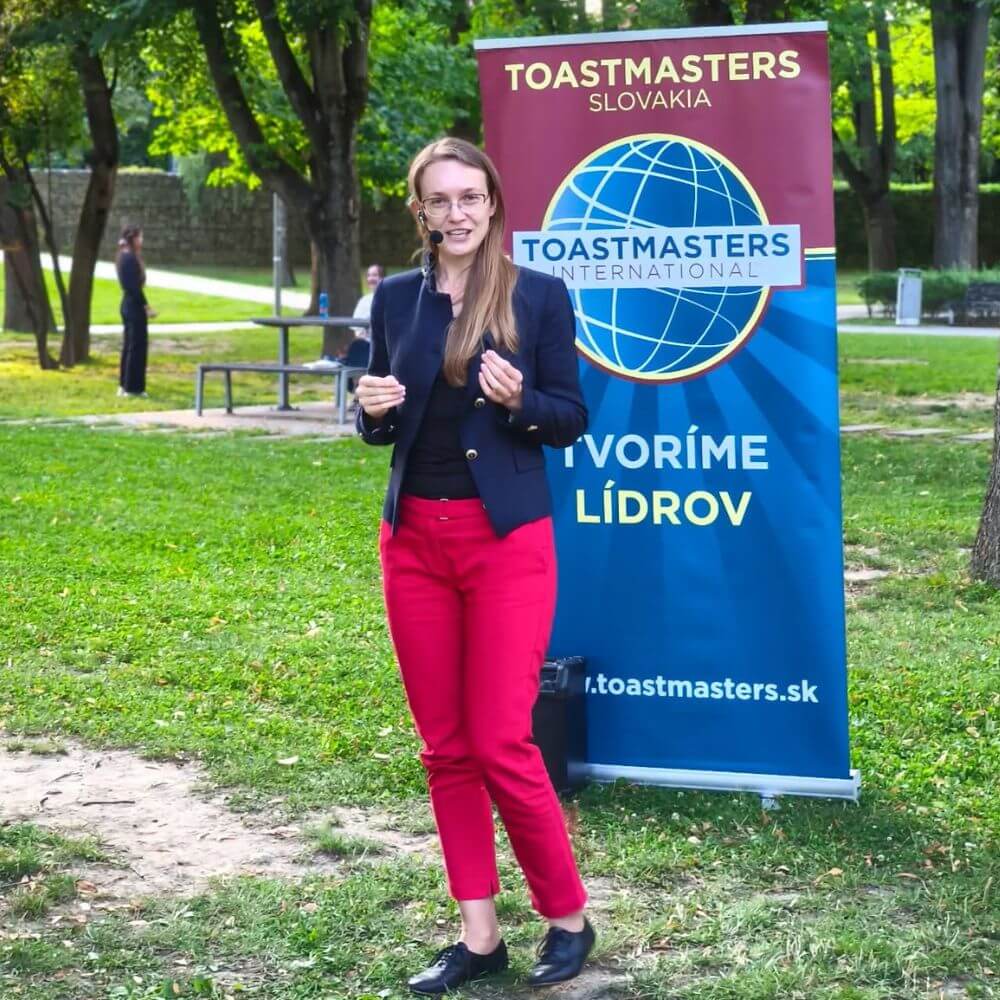
Deliver the message — naturally and convincingly
It's not about reciting a paper, but about making an impact. Saying it in a way that will stick with the person in the room.
→ And this is exactly how we improve our speaking and presentation skills
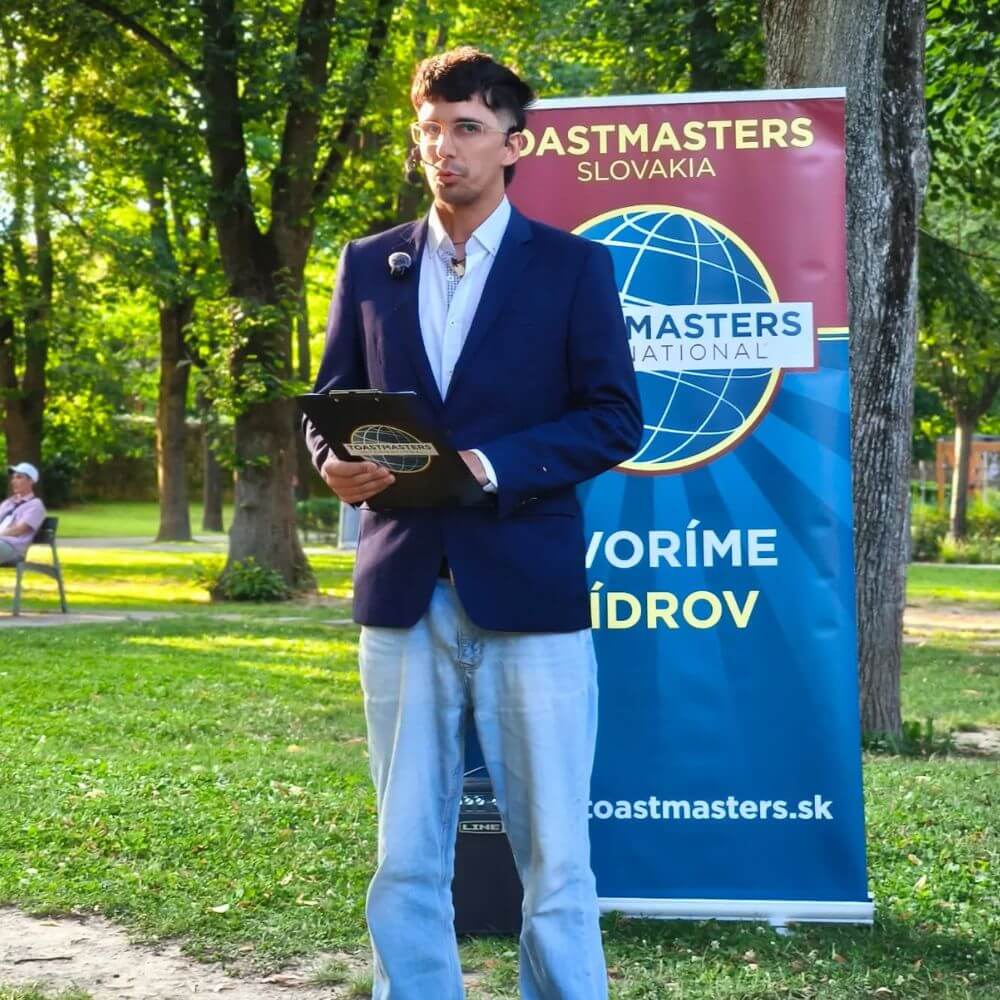
You will receive feedback.
Every speaker has their own evaluator. They will appreciate what worked and recommend what to try differently — always in a constructive spirit.

Speech Evaluation – Marek Dzurilla
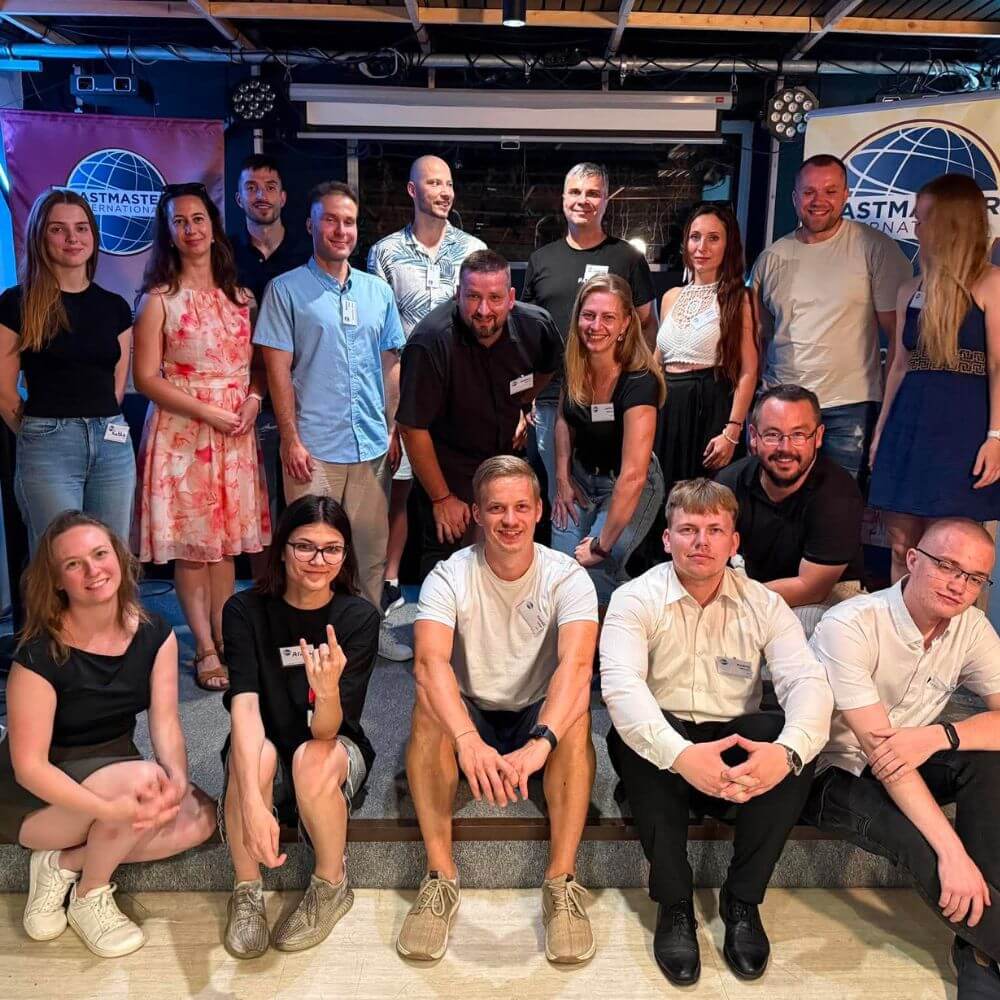
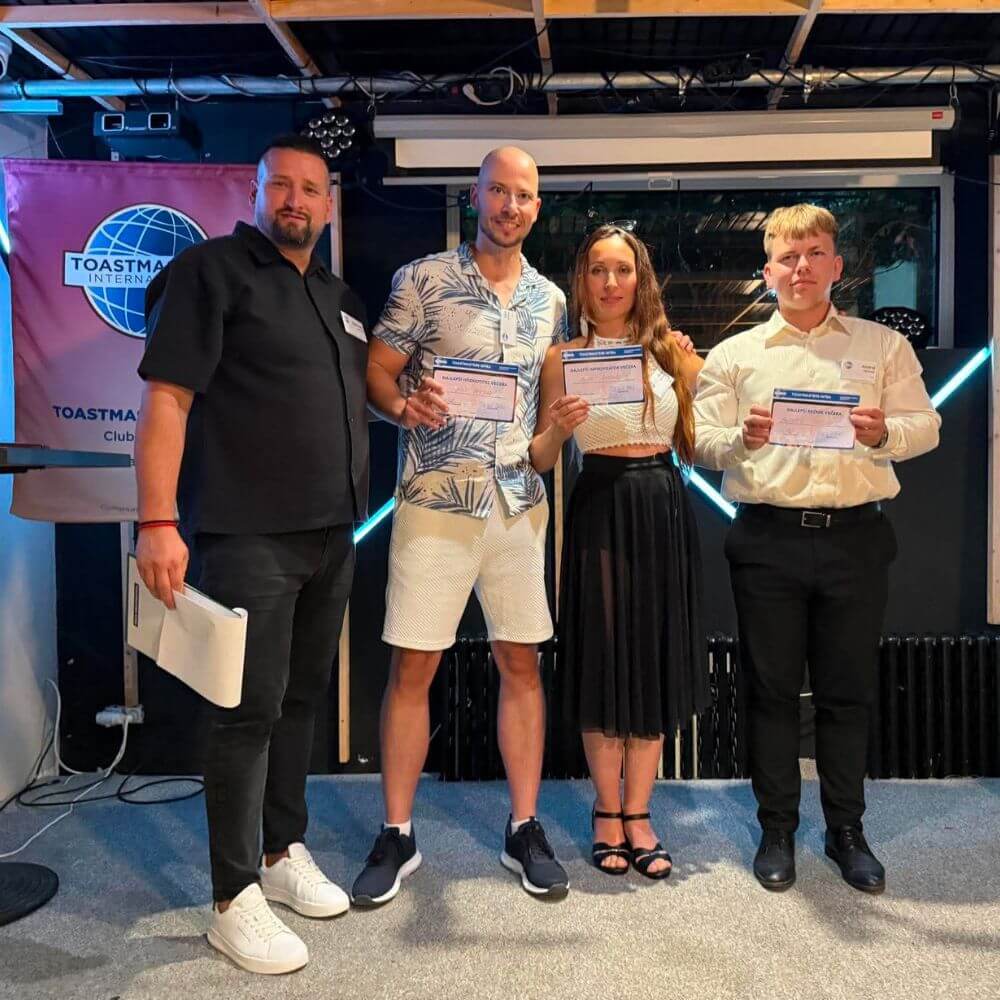
From club life
What does it look like here?
How it works
From member to speaker
At the beginning, you choose a Pathway — the direction you want to grow in. The projects within it guide you in that direction.
You become a member and choose a Pathway
An educational path with a focus — for example, "Dynamic Leadership" or "Visionary Communication." You choose the one that appeals to you.
You progress through levels
The journey is divided into levels, each of which increases the difficulty of preparation and execution.
You choose your projects
Body language, voice modularity, or a project where you repeat the same speech — and incorporate feedback into it the second time.
You will present and receive feedback.
You will receive short feedback from the audience. And most importantly — each speaker has their own evaluator who will assess their strengths and suggest what to try differently.
Cycle
And it all repeats itself
Space for creativity
Even a timekeeper is a public figure
These roles look like administration. They're not. Every time you stand in front of people and say something, it's a performance.
Timer
It's not just about time — we learn to complete a task within the limit. If a speech takes twice as long as it should, something is wrong.
Word cotton collector
It tracks "um," "just," and similar sounds. When you know about them, you can eliminate them.
Attention Keeper
He asks what was said in the speeches. He engages the audience with questions — and he knows how to make it fun.
Language corrector
He watches the language all evening — nice phrases as well as mistakes and unwritten expressions.
Own words
What our members say
Toastmasters gave me the opportunity to work on my strengths and showed me that I would find many hidden fears there too — and that to improve on them, I had to get out of my comfort zone.

Toastmasters gives me a different, often better view of myself — and a more critical one at that. It knocked my socks off. And it made me realize that people don't work the way I want them to, and I have to learn to live with that.

Toastmasters gave me friends — people on the same wavelength. And tools that significantly reduced my fear of public speaking. Plus wagons of inspiration, buckets of motivation, and most importantly, the desire to move from dreaming to concrete actions.

Self-confidence in public speaking. Friends with whom we support each other. And a new perspective on managing and motivating people — both through the structure of the club and through our own speech.

People will forget what you said. They will forget what you did. But they will never forget how you made them feel.
What do you get?
People will start listening to you.
At a meeting, at a celebration, even in a difficult conversation.
Before you come
Frequently asked questions
Do I have to say anything at the first meeting?
No. The guest can just sit and watch the whole evening. The only thing you are expected to do is say your name at the opening introduction — and even that is not mandatory.
Most people come here for the first time because they don't know how to speak in front of people. No one will drag you into anything.
I'm terribly nervous. Isn't this too much for me?
Stage fright is exactly what most people come here with — including those who win competitions today. Shaky voices, cold hands, and the thought of „what will they think of me“ are completely normal. A large portion of our members are introverts and are often among the best speakers because they know how to listen.
It doesn't work by suddenly shaking off stage fright. It works through gradual exposure: first a short improvisation in front of ten people cheering you on, then your first speech, then another. With each performance, your brain gets proof that nothing bad has happened — and the stage fright loses its power. It won't go away completely, but you'll learn to work with it.
How much time and money will it cost me?
The club meets once every one to two weeks and the meeting lasts 90 to 120 minutes. The first visit is free and without registration — you come, you look, you decide later.
Each club determines its own membership fee and will tell you on site. The clubs are non-profit and run by the members themselves as volunteers.
Where do you have clubs and in what language do you meet?
We have clubs in Bratislava, Trnava, Nitra, Trenčín, Žilina and Košice. Most meet in Slovak, but there is also an English-speaking club in Bratislava and an online German-speaking club.
Anyone over 18 years of age can become a member, regardless of education or profession — you'll find programmers, managers, entrepreneurs, students, and people after parental leave.
How is it different from a rhetoric course?
The course lasts a weekend. You perform once or twice, get the materials, and in a month you're back where you were.
Public speaking is a skill — and skill is not built by listening to theory, but by repetition and feedback. Here you perform, you get specific feedback, you process it, and in two weeks you perform again, better. Over and over. That's why it's worked for over a hundred years.
Your journey begins with your first visit
Guests are welcome. Free entry, no registration required. Come take a look and make the first step.