
Learn to lead people. Become a leader.
Toastmasters is a leadership laboratory: Leadership. Motivation. Team. Delegation. Projects.
There is no leader in the world who cannot speak in front of people, with people — and convince.
That's why leadership and speaking are trained together.
Toastmasters is a leadership laboratory
It is a club where 15–20 people regularly train in public speaking and leadership. Leadership here is not an add-on — it is built into the entire organization: from meeting roles to the nationwide team.


Nicole: „Who can I give the opportunity to grow?“

I learned to take responsibility, make difficult decisions, and communicate the vision clearly and respectfully.
Biggest shift: delegating. Trusting others and recognizing their potential — instead of needing to do everything yourself.
A good leader is not someone who has all the answers. He is someone who identifies the potential in others and gives them the trust and space to take responsibility.
How I delegate today:
- I will clarify what needs to be achieved and why.
- I'm looking for a person whose task will shift — not the easiest solution.
- I will hand over responsibility, not a list of steps. Let it be his project.
- I leave room for my own solutions and mistakes.
- I will give feedback when it is finished — the goal is for the person to be able to take on further responsibility.
Toastmasters taught me not to think "I'll do it myself, it'll be faster," but "who can I give the opportunity to grow?"„
— Nicole Bartalska
The biggest problem: leadership cannot be learned from a book
A thousand courses promise to teach you how to lead. Leading people is like swimming — you don't know anything until you're in the water.
You won't get a chance at work.
You only get a leadership role when you prove you can lead. But how do you prove it when no one will let you lead?
Courses are a simulation
Role-playing with strangers at a two-day training. On Monday you are where you were on Friday.
A mistake at work costs a career
A delegation error, a conflict in the team — and you deal with it head-on in front of your boss. No room for error.
Nobody will tell you the truth.
Colleagues are silent, subordinates nod. Without honest feedback, you repeat the same mistakes for years.
Solution: Real accountability with a safe network
You lead real people
You host an evening for 20 people. You organize a competition from A to Z. You run a club. When something goes wrong, it really goes wrong — and you fix it.
→ Exactly what you don't get at work.

A mistake here won't cost you your career or your relationship.
Will you mess up the agenda? The delegation doesn't work out? No one will fire you. A mistake won't cost you a career, a ruined relationship, or a buried marriage. You'll get feedback — and you'll try better next time.
→ Safe environment + real consequences = fastest learning.

The key is to speak in a way that makes people follow you.
No one has ever become a leader by speaking incoherently and without confidence. That's why you're training both speaking and leadership at the same time.

How do you build leadership?
You will take the role
You are leading the way.
You will receive feedback.
You take the bigger one
And it all repeats itself. That's why it works.
Real responsibility
The event is real, people are real—or they aren't. The consequences are real, they just don't cost you your career.
Repetition instead of one-off
Skill is built through repetition, not weekend training. You take on the role again — always one level higher.
Pathways: more leadership than speeches
Pathways has more leadership projects than speaking projects — leadership is at the core of education.
Francis: "I destroyed my trauma and threw it behind my head"„
„"My life was marked by the trauma of elementary school, when I failed to moderate a panel discussion. When I joined Toastmasters and moderated my first meeting, I experienced immense stress. At the same time, I was incredibly proud of myself for destroying my trauma and putting it behind me."“
„As VP of Education, my role was to organize meetings and help members grow through the roles I assigned them to. This gave me confidence and the belief that my actions had meaning and added value to everyone around me. It taught me how to prioritize, organize, delegate, and take responsibility.“

Take responsibility in the club
Club President
You are responsible for the overall success of the club — you lead the leadership team, motivate members, delegate.
You train: team leadership, strategic planning, conflict resolution
Vice President for Education
You plan the meeting agenda and member development — filling roles so that everyone grows.
You train: people development, planning, motivation
Vice President for Membership
You recruit new members and take care of existing ones.
You train: recruiting, networking, working with people motivation
Vice President for Public Relations
You promote the club externally — content, social media, visibility.
You train: marketing, copywriting, brand building
Secretary
Minutes, records, correspondence — the club runs smoothly thanks to you.
You train: organization and precise communication
Treasurer
You manage the club's finances — contributions, expenses, budget.
You train: financial management and transparent communication
And at each meeting, you can try leading an evening:
Meeting moderator
You control the entire evening — the agenda, the energy, the timing.
You are training: group and event management
Chairman
You open the meeting, welcome the guests, set the tone.
You train: first impression and natural authority

The difficulty grows with you
Club Leadership
The president leads and delegates, the VP of Education develops people, the VP of Membership recruits, the treasurer keeps the budget. Your first permanent team.
In the market: team management, delegation, planning, recruitment
Area Director
You lead multiple clubs at once. You coach their leadership, you solve problems that the club cannot solve on its own.
On the market: leadership, coaching, multi-team management
Division and District roles
Nationwide to international team — strategy, division coordination, conferences for hundreds of people.
On the market: strategic leadership, event management, organizational management
Skills that the market pays for
You train them here — members refer them most often, and companies look for them among team leads and managers.
As I learned to give feedback, I learned to diplomatically explain to people what they are doing wrong — minimal emotional damage. „I notice you are using a lot of soft words“ instead of „this is wrong.“ Correction is effective because it doesn’t provoke ego.

Toastmasters has helped me delegate tasks and responsibilities, give and receive feedback, and build more confidence as a team lead. Listening, asking questions, and communicating openly is the path I want to take.
 Lucia Kurucz
He taught me to convey instructions to employees more clearly, to listen more actively to the opinions of others, and increased my confidence when presenting at company management meetings.

Can you lead? and inspire.
This is what you will take away from Toastmasters: you can delegate, give feedback, lead meetings, and organize events. People look up to you and respect you — not because of your title, but because of how you lead.
You train it here. You become a leader. You sell it in the market.
Michal: "They didn't see me for a leadership position — and they were right"„
How expertise took him to the ceiling and leadership let him move on.

I've never been one of the most communicative people — more games, books, and bicycles. Even at work, I tended toward numbers, tables, and analysis.
One day I wanted to move up to a senior position in marketing. I sat in front of the CEO, co-founders, CFO — and the decision came: they didn't see me for it. No one doubted my expertise. I had deficits in team management and communication.
Professional competence and leadership ability are two different things. I have invested years in only the former.
It hurt mostly because they were right. I knew: until I improved this, I would be stuck where I was. Then I remembered Toastmasters — the first meeting convinced me.
Today, I have dozens of appearances and hosting roles, I lead a small team, and I have a nationwide role.
Today I am exactly the leader they were looking for back then.
— Michael
Katarína: "I'm not afraid to take action"„
A ball for 50 people for the 100th anniversary of Toastmasters — from A to Z.
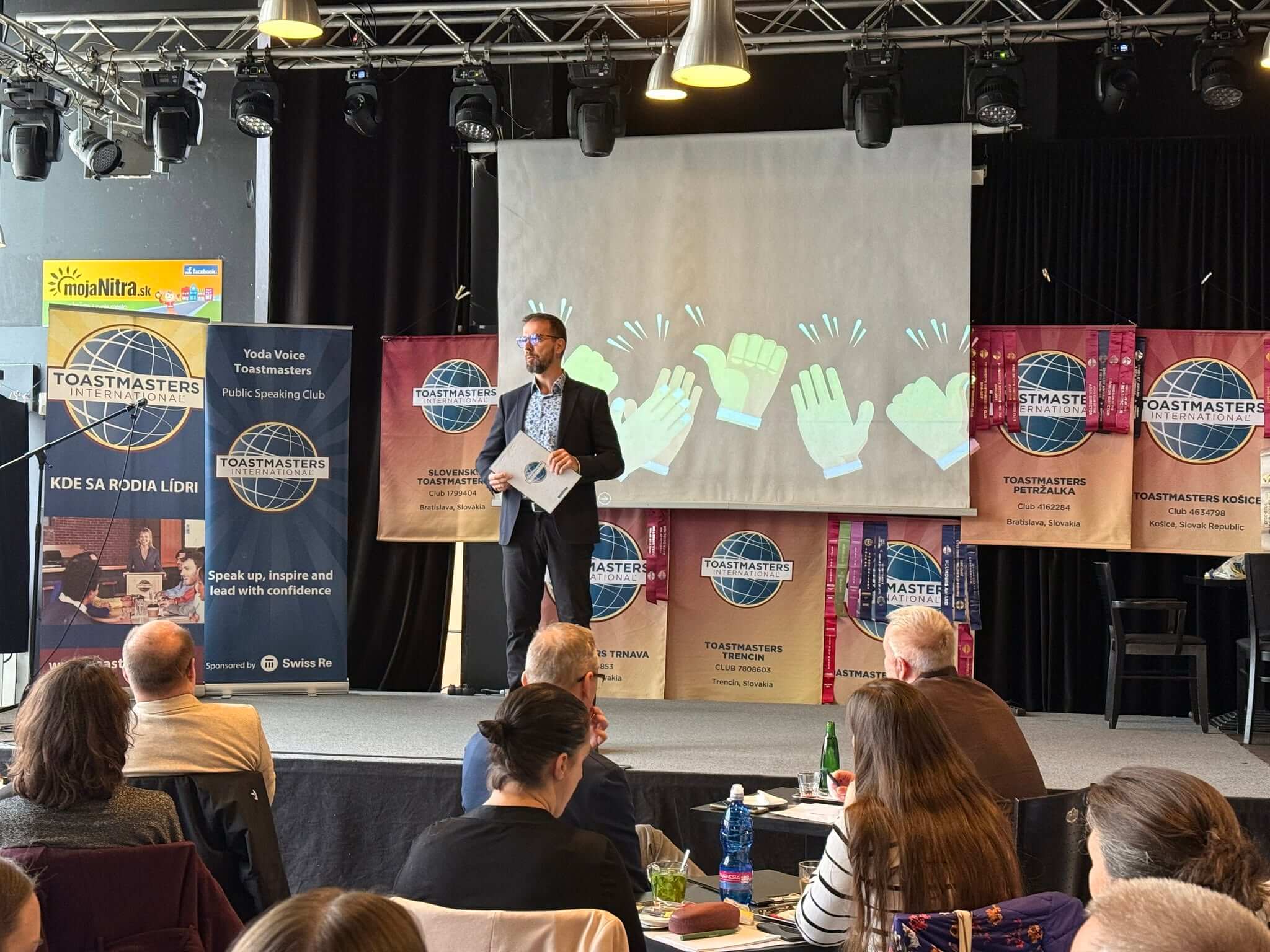
„"Finding a venue, catering, budget and final price, program, marketing, logistics, communication with suppliers — and reconciling different ideas about the event. The preparation took three months. Thanks to effective communication and compromises, we created an event that was a huge success — we were still receiving thank-you messages for days afterward."“
„"When faced with conflicts, I always look at the other side and look for solutions that are common to both parties. Toastmasters helped me resolve conflicts in my team, lead meetings, and build more confidence as a team lead."“

Other members on leadership
I have been in the club management several times, later also as an Area Director. What I have learned the most is working with people — to listen, ask the right questions and not look for one solution that fits all. Instead of ready-made solutions, I ask questions and look for the next appropriate challenge.

The great thing was that I got a "kick" — organizing an educational weekend, being the president, organizing a speech contest. And that I got to choose a team: find, assemble, and motivate people without paying them.

I started to transfer the skills from Toastmasters to reality: workshops in the library, at schools and in the church. I won the Czechoslovak final and today businessmen and politicians pay me to prepare for speeches.

Thanks to Toastmasters, I have become more humble because "if you do nothing, you won't spoil anything". Leadership is about making decisions — and the risk of making mistakes is thus higher. The most important thing is to learn from them, no textbook will teach you that. Top thing: resistance to stress.

I trust myself more. In the past, I would never have started a project and I would have cared more about what people thought.

They helped me the most to better lead and motivate people, delegate, lead meetings, take over project management and build greater self-confidence as a team lead. Bringing an idea into reality.


Mária: "A role is not a list of duties"„
What the role of club president gave Mária.

The role of cashier gave me my first shift: I stopped seeing the role as a list of things to do. Role ≠ list of responsibilities.
The role of president has taught me to ask differently — not „what do I have to do here,“ but what do I need and what can I learn from it. It sounds selfish. It’s not: I’m growing, and that inspires others. So the position has become a playground.
She gave me the space to practice one specific skill — active listening: question → paraphrase → verify → summarize → then solve.
In 1:1, I ask questions before I give advice. In a conflict, I look for specific behaviors, not impressions. When delegating, I check to see if the person really understood me. This works in an interview, a meeting, and at home.
And it gave me the habit of feedback: I went to get it first — to myself, not from myself. I measured myself primitively: „How did I do, 1–10? What will move my number up by one?“ Over the course of a year, that number moved.
— Maria, club president
Questions
Do I need to lead something right away?
No. The first night you just sit and watch. Then a small role — welcoming guests, keeping time. You take on more responsibility when you feel up to it. You climb the ladder at your own pace.
I'm not a natural leader. Does this make sense for me?
That's why. Leadership is a skill like swimming — it's practiced, not inherited. Most of our club presidents started out nervous in front of ten people. Today, they lead teams.
How much time will it take me?
The meeting lasts about 2 hours. The role at the meeting will add a few hours of preparation. Club leadership is a bigger commitment — but that's where the most growth happens.
How much does membership cost?
The first visit is free and without registration. The membership fee varies by club — you will be told about it on the spot. It is symbolic in relation to what you will take away.
What if I mess something up?
You'll screw up — and that's exactly what it's all about. Here, mistakes are cheap: feedback, correction, another try a meeting later. At work, the same mistake can cost you your reputation. Not here.
Come and see.
Guests are always welcome and admission is free. Come and see us at our next meeting.